
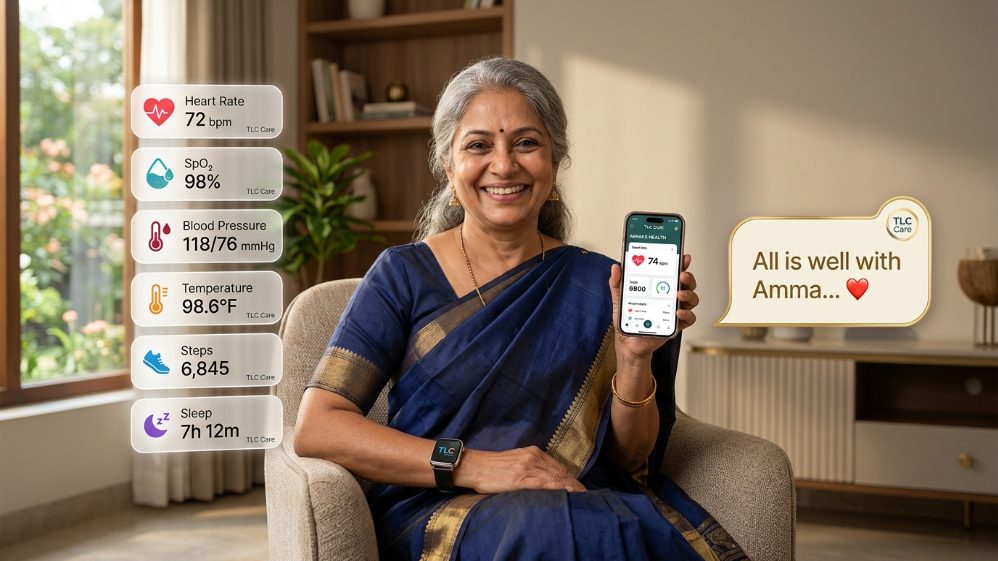
She has a caregiver by her side for eight hours a day. A smartwatch that tracks every heartbeat. A family WhatsApp group that pings every evening without fail. By almost every measure, she is never alone. And yet, if you asked her honestly, she might tell you she feels lonely more often than not. This is the senior care paradox — and it's more common, and more worth understanding, than most families realise.
Presence isn't the same as connection
A caregiver can complete every task on a care plan — meals prepared, medicines given, the house tidy — without a single real conversation happening in the room. None of that is anyone's fault; it's simply what happens when care becomes a checklist rather than a relationship. Families often assume that once the practical needs are covered, the emotional ones follow automatically. They don't. Feeling cared for and feeling cared about are two different experiences, and it's entirely possible to have one without the other.
The friends who aren't there anymore
As people move into their seventies and eighties, their social world tends to quietly shrink. Old friends pass away or move closer to their own children. Neighbours change. Mobility issues make it harder to attend weddings, temple visits, or the weekly card game that used to anchor the week. A senior can be fully embedded in a loving family and still be grieving the loss of a peer group — people their own age who simply understood their references, their era, their humour — in a way no one else quite can.
A daily phone call isn't always a conversation
For adult children living in another city or another country, a nightly call can start to feel like a box to tick rather than a moment to connect: Did you eat? Did you take your medicine? Is the caregiver treating you well? These questions come from love — but stacked one after another, night after night, they rarely leave room for the kind of conversation that actually makes someone feel seen: a memory, an opinion, a joke, a worry that has nothing to do with logistics. Distance makes this harder to notice, not easier.
When care starts to feel like being watched
Technology has made it possible for families to know, at any moment, that a parent's vitals are normal and their day is going fine — and for many families, that reassurance is genuinely life-changing. But monitoring alone can start to feel less like companionship and more like supervision if it isn't paired with real, human interaction. A notification that says "all is well" is not the same as someone sitting down to ask how she's actually doing. The technology works best as a safety net underneath real connection — never as a replacement for it.
The quiet grief of needing help
There's a loss that rarely gets talked about openly: the shift from being the one who cared for others to being the one who needs care. For many seniors, accepting help — with bathing, with walking, with remembering things — comes with a private grief about independence and identity that a full schedule of visitors and caregivers doesn't automatically resolve. Loneliness, in this sense, isn't always about the absence of people. Sometimes it's about feeling like a patient rather than a person, even in a room full of people trying to help.
What genuine companionship actually looks like
The antidote isn't more people in the room — it's the right kind of presence. At TLC Care, we match caregivers by language, personality, and shared interests, not just availability, because a caregiver who can talk cricket, discuss the news, or sit through an old Malayalam film with genuine interest changes what a day feels like. Wherever possible, we keep the same caregiver with a family over time, because trust and real conversation take longer than a single visit to build. Care that includes companionship isn't a nice-to-have add-on — it's often the difference families notice first.
Signs your parent may be experiencing loneliness
Loneliness doesn't always announce itself. A few things worth paying attention to:
- Losing interest in hobbies or routines they used to genuinely enjoy
- Repeating the same stories often, or seeming eager to keep any conversation going
- Sleeping much more than usual, or low energy with no clear medical cause
- Reluctance to end phone calls or visits, even when they say they're "tired"
- A cheerful "I'm fine" that doesn't quite match their tone or body language
Start with presence, not just care
If any of this feels familiar, it doesn't mean the care your parent is receiving is failing them — it usually just means the emotional piece needs the same intentional attention as the physical one. Sometimes that's as simple as a caregiver chosen for companionship as much as competence. Sometimes it's a weekly call that starts with "tell me something good that happened today" instead of a checklist. A TLC Care coordinator can help you think through what genuine connection could look like for your family — with no pressure, and no obligation.